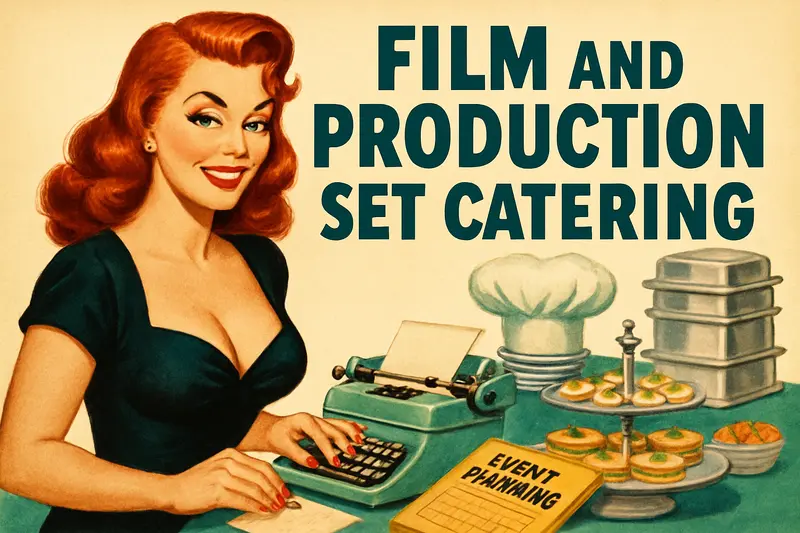
Why Film Set Catering (Craft Services) Is a High-Margin Opportunity Most Caterers Ignore
I've been running catering operations for nearly twenty years, and I can tell you without hesitation: film and production set catering is one of the most underutilized revenue streams in our industry. Most caterers don't pursue it because they think it's too complicated, too specialized, or requires connections they don't have. That's exactly why there's money on the table.
Let me be direct about the financial opportunity. A single film production gig can generate $5,000 to $15,000 per week in catering revenue, depending on the size of the crew and the production's budget tier. Compare that to a standard corporate lunch for 75 people—you're looking at maybe $1,500 in total revenue. On a film set with 80-150 crew members, you could be doing $8,000 to $12,000 in a single week, with multiple weeks of consecutive work on the same shoot.
The margins on craft services work are also superior to traditional catering. You're providing simpler food (breakfast items, snacks, beverages, lunch items), but you're doing it at premium pricing because production companies have budgets built into their schedules for craft services. They expect to pay more, and they budget for it. A muffin that costs you $0.85 to source and prepare sells for $4-5 on set. Coffee that costs you $0.40 per cup sells for $2-2.50. That's not gouging—that's what the market bears, and producers expect it.
But here's the catch: getting your first production job requires a different approach than your standard B2B catering sales. You can't just call a line producer and pitch the same way you'd pitch a corporate account manager. The industry has specific expectations, specific rhythms, and specific people who make the decisions. Understanding those nuances is the difference between landing consistent work and spinning your wheels.
In this guide, I'm sharing exactly how I broke into production catering, how I've landed repeat work, and how I've scaled it to become 30% of my annual revenue. This isn't theoretical. This is what actually works.
Understanding the Craft Services Industry Structure and Who Actually Makes the Hiring Decisions
Before you can sell to the film and production industry, you need to understand how it's organized. Most caterers fail here because they don't know who to pitch or what they're actually selling.
Free Industry Starter Kit
Everything you need to grow your business with AI assistance.
Film productions are organized by budget tier. A feature film produced by a major studio has a completely different catering budget and expectations than an indie film shot in 14 days on a shoestring budget. A commercial shoot for a national brand (we're talking Super Bowl ads, major campaigns) pays differently than a local TV pilot. A streaming show has different expectations than a theatrical release. Understanding these distinctions is critical because it determines your pricing, your service model, and who you're actually pitching.
The person hiring craft services is typically the Production Manager or the Line Producer. On very large productions, there's sometimes a separate Craft Services Supervisor—but they don't hire vendors; they oversee the catering that's already been booked. The Line Producer is the person managing the budget and logistics. They're the one who sends out requests for proposals to catering vendors. On smaller productions (indie films, commercials, corporate videos), the Director of Production or even the Producer might handle it directly.
Here's what's critical: these people receive dozens of catering inquiries. They don't care about your photo gallery or your Instagram follower count. They care about four things, in this order: Can you hit the budget number they specify? Can you show up at 5 a.m. when they tell you to? Do you understand the logistics of feeding a moving crew? Can you handle the specific dietary requirements and volume they need?
"When I get a catering inquiry for a film production, I'm immediately looking at three things: Does this vendor understand that we need food ready by call time (not close to call time), do they have the infrastructure to handle a 100-person breakfast service in a location van, and can they give me a price-per-person or price-per-day number I can plug into my budget without back-and-forth?" — Sarah Chen, Line Producer, 15+ years experience
The people making these decisions work insane hours. Your Line Producer is on set 12-16 hours a day managing every moving piece of the production. They didn't sleep more than 4 hours last night. They have 47 emails in their inbox. When they email you about craft services, they want a response within 2 hours, not 2 days. This is another place most caterers fail—slow response time costs you jobs.
Production companies often use casting and crew hiring platforms like LinkedIn, Facebook Groups dedicated to crew hiring (there are dozens of these, organized by region and production type), and industry-specific networks. Some productions post on general job boards. Others go through established production catering vendors they've used before. But even the established vendors started somewhere, and they're constantly looking for backup options because productions change locations, scale, and timelines constantly.
The key insight: your job isn't to convince a production company they need catering. They already know they do. Your job is to convince them you can execute their specific requirements on their timeline at their budget. That's fundamentally different from selling catering to a corporate client.
Finding and Landing Your First Film Set Catering Contract
Now that you understand the landscape, let's talk about getting your first job. This is where many caterers get stuck. You can't just sit back and wait for inquiries—you need to actively find productions and pitch yourself.
Start with the Facebook Groups. Search for "[Your Region] Film Crew," "[Your City] Production," and "Film Crew [State]." You'll find dozens of active groups with thousands of members. These groups are where crew gets hired, where producers post job postings, and where vendors advertise. Join every single relevant group for your region and adjacent regions. Within these groups, you'll find producers and line producers actively hiring crew and vendors. Introduce yourself as a catering vendor and ask if anyone is hiring for upcoming productions.
Be specific about what you offer and be transparent about your experience level. "Hi, I'm a catering operator expanding into production catering. I can handle breakfast service, lunch, snacks, and beverages for crews up to 100 people. Looking to book my first production gig and build this line of business. What productions are hiring caterers?" This actually works. People appreciate honesty, and production companies know they need vendors. Someone in that group will have a connection.
Next, identify local production companies and studios in your area. If you're in a major media market (Los Angeles, Atlanta, New York, Austin, New Orleans), there are dozens. If you're in a smaller market, there might be only a handful. Make a list. Go on LinkedIn and search for Line Producers, Production Managers, and Producers in your area. Connect with them. Don't immediately pitch. Send a message saying: "I noticed you're involved in film production in [City]. I'm a catering operator and I'm building my craft services business. I'd love to connect, and if you're ever looking for catering options for a production, I'd welcome the chance to quote it." Some will ignore you. Some will bookmark your profile. When they need a caterer, they'll reach out.
Third, identify the key production catering vendors already working in your market and study what they're doing. Are they advertising? What are they charging? What's their service model? You're not copying them—you're learning the baseline. If you're in a market where craft services are well-established and expensive, that might be an opportunity. Maybe you position yourself as the "lean, efficient alternative" that can hit tighter budgets. If the market is underserved, that's your opening.
Fourth, reach out directly to productions that are actively filming or about to start. How do you find them? Industry sites like ProductionHUB, The Industry Standard, and Entertainment Career Network list active productions by region and update regularly. You can also search local film commission websites—most cities and states have film commissions that track active productions. Call or email the production office directly and ask to speak with the Line Producer about craft services catering.
When you make first contact, your pitch should be efficient and specific. Here's the template I've used:
- Introduce yourself and your service: "Hi [Name], I'm [Your Name], owner of [Catering Company]. We provide on-set craft services for film and TV productions."
- Demonstrate relevant understanding: "I understand you're filming [Project] and I wanted to reach out about catering options for your crew."
- Make the ask simple: "Could we set up 15 minutes to discuss your catering needs and timeline? I can send you pricing and options."
That's it. Don't oversell. Don't send a giant proposal attachment. Make it easy for them to say yes to a quick conversation.
Understanding Production Catering Requirements and Service Models
Once you've made contact with a production company, you need to understand exactly what they're asking for. This is where the details matter enormously, because film catering is operationally different from restaurant catering or corporate event catering.
There are several distinct service models in production catering, and the producer will tell you which one they need. The first is "Craft Services Only," which means you're providing snacks, beverages, and small items throughout the day—the "crafty table." Typically, this means coffee, tea, water, juice, sodas, energy drinks, fresh fruit, muffins, bagels, granola bars, candy, nuts, and similar grab-and-go items. Crew members hit this table during breaks. Craft services operates from call time (when the first crew members arrive) until wrap (when they're done shooting). Call time is often 5 or 6 a.m. Wrap can be anywhere from 5 p.m. to midnight, depending on the production schedule.
The second model is "Breakfast and Lunch," which means you're providing a sit-down or buffet-style breakfast at call time and a full lunch around midday. This requires more infrastructure—you need serving tables, warming equipment, plating supplies, and the ability to serve 50-200 people in a condensed timeframe (usually 30-45 minutes for breakfast before shooting starts).
The third model is "Full Catering," which includes breakfast, lunch, dinner, and craft services throughout the day. This is the most demanding and also the most lucrative. You might bring in $10,000-15,000 per week on a larger production because you're the sole food provider for the crew.
Each model has different cost structures and requires different equipment. Here's what I've learned: crews on set don't want elaborate, complicated food. They want something they can eat quickly, something that doesn't make a mess on set, and something that hits their dietary preferences (which can vary wildly). A typical breakfast service on a film set looks like: coffee, tea, juice, bagels, pastries, fruit, and yogurt. Maybe some scrambled eggs if you're doing a sit-down breakfast. That's it. Don't overthink it.
"The difference between a good craft services vendor and one who doesn't get hired again comes down to logistics and communication, not fancy food. Can you have hot coffee ready at 5:45 a.m.? Can you restock the snack table every two hours without being intrusive? Do you answer texts from the set at 2 p.m. about dietary issues? That's what I care about." — Marcus Thompson, Production Manager, 8+ years
Pricing models for production catering vary. Some productions want a "per-person-per-day" rate. Others want a total weekly cost for specified meals and craft services. Some want "per-meal" pricing. You need to be flexible with your quotes, but here are the current market rates (as of 2024, adjusted for your regional market):
- Breakfast service (per person): $8-12 depending on menu complexity
- Lunch service (per person): $12-16 for a buffet-style lunch
- Craft services only (per person per day): $4-6
- Full day of catering (breakfast, lunch, craft services, per person): $18-25
- Weekly craft services (exclusive vendor on set): $3,000-5,000 per week plus food costs
These numbers assume a crew size of 75-150 people. Smaller crews often have higher per-person costs. Large productions (network TV shows, major studio films) sometimes negotiate lower per-person rates but guarantee higher volume and longer contracts.
When you're quoting production catering work, you need to know the crew count, the meal schedule, the filming location(s), how long the gig lasts, and any specific dietary requirements. Ask for all of this in writing before you submit a quote. "Are we talking 80 people or 150?" makes a $2,000 difference in your weekly cost.
The Operational Challenges of Feeding a Moving Production Crew
This is where most caterers without production experience get blindsided. Feeding a film crew is operationally different from catering a corporate event or wedding reception. The constraints are severe, and if you don't understand them, you'll either lose money or get bad reviews that kill your chances of future work.
First challenge: early morning timing. Most productions call talent and crew at 6 a.m. or earlier. You need to have hot breakfast items ready to serve by 5:45 a.m. in most cases. That means you're starting food prep at 3 a.m. or earlier. This isn't optional. If you show up at 5:50 a.m. with cold bagels and no coffee, you won't get hired again. Ever. You need reliable staff who can show up that early consistently. In my operation, we typically stagger start times: some team members arrive at 2:30 a.m. to handle hot items, others arrive at 4 a.m. to set up service tables and cold items.
Second challenge: location variability. Productions don't always film in one place. A show might film in a studio one day and on location (an actual house, a street, a parking lot) the next day. For location shoots, you need to bring everything with you—no access to commercial kitchens, sometimes no access to running water or electricity. You're working out of a production van or from tables in a parking lot. You need serving equipment that's portable: cambros (insulated food containers), chafing dishes, coolers, serving utensils, plates, cups, napkins. Most caterers don't own enough of this equipment. If you're serious about production catering, you need to invest in it.
Third challenge: dietary restrictions and allergies. The level of dietary complexity on a film set is often higher than on a standard catering event. You might have crew members who are vegan, gluten-free, kosher, halal, nut-allergic, and dairy-free—all on the same production. You need systems to track who has what restrictions and to ensure meals are labeled and separated properly. A single allergy incident can create legal liability and will definitely get you removed from the production.
Fourth challenge: speed of service. You have a limited window to get everyone fed. For a sit-down breakfast, you might have 45 minutes before the first shot is called. For craft services replenishment, you need to notice when items are running low and restock without interrupting shooting. You can't be on set while cameras are rolling—the set is closed. You need to monitor without being intrusive. On some sets, you're communicating via text message with the Production Assistant or Set Manager: "We're low on coffee, can I come restock?" Then you wait for the green light to move in.
Fifth challenge: accountability and tracking. Most productions require you to track and document what you provided each day, the crew count, any issues, and special requests. You need systems for this. I use a simple spreadsheet that logs: date, crew count, meals provided, time of service, dietary items prepared, restocks, and any notes. Production companies may audit this for budgeting purposes.
Sixth challenge: long hours and unpredictability. A production that's scheduled to wrap at 7 p.m. might run until 11 p.m. if they're behind schedule. You need to be prepared to extend service. Your crew needs to stay late. You need to have contingency food on hand. This is factored into your pricing, but it's also a real operational challenge. Your team members need to understand they might work 14-hour days on a film production.
Here's my advice: for your first production gig, keep the scope tight. Offer craft services only, or breakfast and lunch—not the full meal plan. This lets you prove yourself with fewer moving parts. Once you've done two or three productions successfully and built relationships with producers, you can expand to more complex service models.
Pricing Your Services Competitively While Protecting Margins
Pricing production catering is a balance between hitting the producer's budget and protecting your actual margins. This is where I see caterers make critical mistakes. They either price too low to "win" the business and lose money, or they price too high and don't get the work.
Start by calculating your actual costs. For a craft services daily rate, I include: cost of food, packaging/service supplies, transportation, labor (your time plus staff time), equipment wear and tear, and a contingency buffer. Let me walk through a real example.
Let's say you're quoting craft services for a 100-person crew, daily rate, 5-day week. Your daily costs might look like:
- Food cost (coffee, tea, juice, fruit, snacks, bagels, pastries): $250
- Packaging and serving supplies (cups, napkins, plates, utensils, service containers): $80
- Labor (2 staff members, 10 hours each at $18/hour): $360
- Transportation and vehicle costs: $40
- Equipment rental or depreciation (coolers, chafing dishes, serving table): $30
- Total daily cost: $760
If you're charging $5 per person per day for craft services with 100 people, that's $500 per day revenue. You're losing $260 per day. That's not sustainable. You need to either charge more or reduce your costs. In this case, $7-8 per person per day gets you to profitability. At $7 per person, you're doing $700 per day revenue against $760 cost, which is still too thin. You need $8 per person ($800) to hit a healthy margin where you're covering unexpected costs and building profit.
But what if the production's budget is only $4 per person? Then you need to adjust the scope: maybe you provide coffee, tea, water, and a limited snack selection instead of full breakfast items. Or you negotiate a higher per-person rate but reduce the crew count they expected. Or you say no to the job. Pricing your services too low to "get in the door" is a trap. The producer will expect the same low rate for every future job, and you'll train them to devalue your service.
Here's what I recommend: price based on your actual costs plus 25-35% margin. If they come back and say the price is too high, have a conversation about scope reduction. Don't just drop your price. "Our pricing is based on [X] and [Y]. If that's outside your budget, we could modify the service to include [lower-cost items] and hit your target number." This keeps you in control of the conversation.
Production catering pricing is also regional and market-dependent. In major markets like Los Angeles, Atlanta, and New York, rates are higher because both crew rates and overall production budgets are higher. In secondary markets, rates are 15-25% lower. Know your local market before you quote.
One more critical point: always get the details in writing before you quote. I use a simple email template requesting: crew count, filming location(s), start date and end date, call time, expected wrap time, meals/services needed, and any dietary restrictions. Once you have this, you can quote accurately. Never give a ballpark number and then find out later they actually need 150 people instead of 80.
Building Relationships With Producers and Getting Repeat Work
Landing your first production gig is the hardest part. Keeping the gig and getting repeat work is about execution and relationships. I've built production catering to 30% of my revenue specifically because I've prioritized this relationship-building.
Here's how repeat work actually works in the production industry: a Line Producer has a good experience with your catering, and when that production wraps, they remember you. Their next production comes up in 4-6 months, and they reach out to you first. That producer also talks to other producers. "Hey, we used this catering company for our last shoot, they were great—handled early mornings, no drama, hit our budget. I have their contact info if you need it." That's how you build a pipeline. One good experience generates 2-3 referrals.
The key to this is being exceptional on your first job. I mean operationally flawless. Show up 15 minutes early with more than enough food. Have hot coffee at call time. Restock the craft table without being asked. Handle dietary requests without making it complicated. Answer your phone when the Set Manager texts at 2 p.m. with a last-minute dietary need. Do what you said you'd do, hit your budget, and leave no surprises.
Beyond execution, stay in touch with the producers you work with. After a production wraps, send a thank-you email within a week: "Hi [Producer], it was great working with you on [Production]. Thanks for the opportunity. If you have any feedback, I'd love to hear it—looking to keep improving. Hope our paths cross on your next project." Keep it brief. Don't oversell. Just remind them you exist and you appreciate the work.
Then, every 3-4 months, send producers you've worked with a brief check-in: "Hi [Producer], wanted to see if you have any upcoming projects that might need catering. I'm expanding this line of business and would love to work with you again." That's it. You're staying top-of-mind without being annoying.
Create a database of every producer, line producer, and production company you interact with—even ones that don't hire you. Include their email, phone number, the projects they've worked on, and any personal notes (e.g., "prefers working with vendors who can handle crew of 200+ people"). When you need to do outreach, you're working from a real contact list, not cold-calling strangers.
Timing also matters. Most film productions plan their catering vendor needs 4-6 weeks before the shoot starts. If you're reaching out in that window, you're more likely to catch someone who's actively solving the problem. Reaching out to a producer when they're 2 weeks into a production looking for a different caterer is harder. You need to be proactive and reach out before they're desperate.
Another key lever: be the vendor who can handle last-minute changes without freaking out. Productions change. A crew count that was estimated at 80 suddenly becomes 120 because they hired more extras. The location that was supposed to be indoors is now outdoors and there's no shelter. The production that was supposed to run 5 days is now running 7 days. Producers remember vendors who handle these changes gracefully. "Oh, we need to add 40 more breakfasts tomorrow? Let me make a quick call, but yes, we can do that." That kind of responsiveness builds loyalty and leads to more work.
Essential Equipment and Infrastructure You'll Need to Invest In
Many caterers think they can start production catering with their existing catering equipment. That's partially true, but you'll hit limitations quickly. Production catering has specific equipment needs.
At a minimum, you need: a reliable vehicle that can carry food safely (refrigerated if you're carrying cold items), multiple cambros (insulated food containers in various sizes—budget $300-500 each, and you'll want 6-8 of them), chafing dishes with fuel cans, serving utensils and ladles, serving tables or a portable serving station, coolers (large ones for ice and beverages), a coffee and tea service setup, and food storage and prep containers.
For breakfast service, you also need warming equipment. Some caterers use electric chafing dishes, some use fuel-based ones. Fuel-based requires carrying fuel and managing it safely on set. Electric requires access to power. You might need both options depending on location.
Total equipment investment for basic production catering setup: $3,000-5,000 to start. As you grow, you'll want a dedicated production catering van with built-in refrigeration and warming equipment. That's a $25,000-40,000 investment, but it makes you far more efficient and professional.
Insurance is also critical. You need general liability insurance that covers mobile catering and production work. Your existing catering insurance might not cover on-set catering in all locations. Talk to your insurance provider about adding production catering to your policy. This typically costs $400-800 per year extra depending on your coverage limits.
Software for tracking orders, crew counts, dietary requirements, and invoicing makes a huge difference. You don't need something fancy—I started with a spreadsheet and Google Forms. As I grew, we invested in a catering management platform that integrates with our ordering and invoicing systems. This reduced mistakes and made communication with productions clearer. Consider this as you scale.
Scaling Production Catering Into a Significant Revenue Stream
Once you've nailed your first few gigs and built relationships with producers, you can scale this intelligently. Here's my framework for growing production catering without it consuming all your existing business capacity.
First, segment your business. Don't try to run a full wedding/corporate catering operation and production catering out of the same kitchen with the same staff. They have different operating rhythms. Wedding catering is project-based with unpredictable timing. Production catering is contract-based with predictable weekly schedules. Manage them separately. This might mean dedicating one team member or one shift to production work, or it might mean a completely separate operation. The goal is to prevent production catering from disrupting your existing business.
Second, develop standard menus for production catering. Don't re-invent the menu for every job. "Here's our standard breakfast package, here's our craft services package, here's our lunch package." This simplifies your operations, makes quoting faster, and lets you build efficient sourcing and prep workflows. You can customize within reason, but start with templates.
Third, build relationships with backup catering vendors you trust. If you get multiple productions running at the same time (which happens), you might need to sub out some service to another caterer. You're the vendor of record, but you partner with another team to handle the overflow. Build these relationships before you need them.
Fourth, automate your quoting and communication. Create a standard quote template that you can customize and send within an hour of receiving a request. Production companies are time-sensitive. The faster you quote, the higher your chance of getting the gig. I also set up an automated email follow-up system: if I quote a production and don't hear back within 48 hours, I send a quick follow-up: "Hi [Producer], just checking in—are you ready to move forward with our proposal, or do you have questions?" This simple follow-up converts 10-15% of quotes that would otherwise get lost.
Fifth, track your metrics. Which productions turned into repeat work? Which producers are your biggest advocates? Which service models are most profitable? Which crew sizes are most efficient to serve? Use this data to make decisions about which gigs to pursue and which to pass on. Not every production job is worth doing. A 60-person crew in a remote location with minimal repeat business might be worth less than a 100-person crew at a major studio lot that's doing multiple productions.
Strategic growth in production catering looks like this: Year one, book 5-8 productions and build relationships. Year two, because of referrals and repeat work, you're handling 12-15 productions across the year, with some overlap. By year three, you have predictable recurring clients (certain producers who book you for multiple projects per year) and a strong referral network. Production catering becomes a reliable revenue stream that doesn't require constant new business development.
For reference, in my operation, production catering went from zero to 30% of total revenue over three years, not because I was aggressively hunting new gigs, but because execution on early jobs led to consistent referrals and repeat business. The compounding effect of word-of-mouth in the production industry is powerful.
Avoiding Common Mistakes That Kill Production Catering Businesses
I've seen caterers enter production catering with enthusiasm and then quit after 2-3 gigs. Usually, it's because they made one of these mistakes. Learn from their experience instead of repeating it.
Mistake 1: Underpricing to win the first job. You're competing for a job against other caterers, so you drop your price to $4 per person instead of your target $7. You win the job. You lose money on it. Now the producer expects $4 per person for all future work. You're stuck or you have to risk losing them by raising rates. Don't do this. Charge what you need to charge. If you don't get the job, that's okay. You'll get the next one.
Mistake 2: Not showing up operationally. You're late. Your coffee is cold. You forgot to ask about dietary restrictions and now there's a gluten situation at lunch. You didn't restock the craft table and crew is complaining by day three. You don't answer your phone when the Set Manager needs to reach you at 1 p.m. These operational failures are conversation-enders. You will not work in that production community again. The stakes are higher in production catering because word-of-mouth is everything.
Mistake 3: Taking jobs you can't handle. A production books you for 200 people and 7 days of full catering (breakfast, lunch, dinner, craft services), and you've never done anything bigger than 80 people. You're overcommitted. Something breaks down. You can't fulfill it. This destroys your reputation faster than anything else. Know your capacity. Take jobs you can win at.
Mistake 4: Not tracking costs carefully. You get through the first production, and you assume you made money because you didn't go negative. But you didn't actually calculate what your costs were versus what you charged. You made $3,000 on a week-long job, but your labor and food cost you $2,800. That's a 7% margin. You can't scale on 7% margins. Track every cost, every hour of labor, every item you purchased. Know exactly what you made and where the money is.
Mistake 5: Treating production catering as a side hustle.** If you're not committed to excellence, don't bother. Producers can tell. They'll hire someone who's all-in on production catering over someone who's treating it as extra revenue. If you do decide to pursue it, commit to it fully for at least 6 months. Build the infrastructure, hire the team, make the relationships. Then decide if you want to scale it further.
The flip side of these mistakes: execution, communication, reliability, and treating production work as a serious business line is what builds a sustainable production catering operation. It's not complicated, but it requires focus and discipline.
If you're ready to expand your catering business into production work, start small—pick your first production job carefully, execute flawlessly, and let referrals and reputation build from there. The financial opportunity is real, the market is active, and there's room for caterers who understand the industry and can deliver operationally. You can also leverage technology and automation to streamline your broader catering operations, which allows you to focus more effectively on production work. Consider exploring AI for Catering Companies: Automate Inquiries & Booking to free up time and resources for this higher-margin work. Additionally, understanding how to cater for large events (200+ guests) translates well to production crews, and mastering corporate catering relationships can help you build the same trust and reliability that producers expect.